
Beyond the Prompt: Transitioning Your SMB to Autonomous AI Agents in 2026

Last Updated 5 months ago ago
The 2026 Inflection Point: From Generative Hype to Agentic Results
The global business landscape in 2026 has undergone a fundamental structural transformation, moving decisively past the experimental “innovation theater” that characterized the previous two years. In 2025, organizations were largely consumed by the challenge of “learning to prompt,” a period defined by human-triggered, reactive AI interactions where Large Language Models (LLMs) served primarily as sophisticated drafting assistants. However, the current era is defined by the emergence of Autonomous AI Agents for Business, marking a shift from software that merely assists in work to digital entities that autonomously perform and manage complex business operations. This transition represents the most significant evolution in enterprise technology since the mass migration to the cloud, as businesses move from “copilots” to “autonomous teammates” capable of reasoning, planning, and taking accountability for end-to-end outcomes.
Market valuations and adoption metrics confirm the scale of this “agentic economy.” International Data Corporation (IDC) projects that the number of active AI agents globally will surge from approximately 28 million in 2025 to over 2.2 billion by 2030, with the volume of tasks executed by these systems growing at a staggering 524% compound annual growth rate (CAGR). By the end of this decade, autonomous systems are expected to handle approximately 415 trillion tasks annually. For the Small and Medium Business (SMB) sector, this shift is not merely a technical upgrade but a strategic necessity to overcome “digital debt”—the accumulation of emails, chats, and administrative friction that has historically created a productivity ceiling for growing firms.
According to the latest reseach, technology has become an infused force where automation and advanced analytics are joined by AI agents inserted directly into company workflows. This paradigm shift promises exponential productivity gains, faster speed to market, and significant cost reductions, forcing leaders to reimagine how work gets done and rethink traditional organizational structures. The focus for forward-thinking SMB owners in 2026 has shifted from how they can use AI to how autonomous agents can independently run business operations, allowing human leadership to focus on high-level strategy and innovation.
|
Metric |
2025 (The Learning Era) |
2026 (The Agentic Era) |
|---|---|---|
|
Core AI Model |
Generative/Assistive |
Autonomous/Agentic |
|
Primary User Interaction |
Prompting (Reactive) |
Goal-Setting (Proactive) |
|
Functional Scope |
Isolated Task Completion |
End-to-End Workflow Ownership |
|
Technology Infrastructure |
Standalone Chatbots |
Integrated Orchestration Hubs |
|
Organizational Focus |
Efficiency Tweaks |
Structural Capability Overhaul |
|
Data Relationship |
Retrieval-Based |
Context-Aware and Memory-Driven |
The Structural Anatomy of Autonomous AI Agents for Business
To understand the 2026 competitive landscape, it is essential to distinguish between the “passive” AI of the past and the “agentic” AI of the present. While generative AI could describe work, agentic systems can actually do the work—navigating software, executing multi-step sequences, and self-correcting when errors occur. These agents are built on a sophisticated architectural stack that includes reasoning engines, tool-utilization layers, and episodic memory, which allows them to remember past actions and learn from historical mistakes to optimize future execution.
The hallmark of the 2026 agent is “proactive autonomy.” Instead of waiting for a human prompt, an autonomous supply chain agent continuously monitors external signals, such as weather delays or port strikes. When it detects a disruption, it does not merely flag the issue; it traces the defect to specific materials, identifies alternative suppliers with available stock, drafts purchase orders, and notifies the relevant floor manager with a concise summary of the corrective action taken. This proactive stance allows SMBs to maintain 24/7 operational velocity and achieve a scale previously reserved for multinational corporations.
Furthermore, the introduction of Agent-to-Agent (A2A) coordination has enabled the creation of specialized digital workforces. Rather than designing one massive agent to handle every business function, organizations now compose systems of specialized agents that mirror human team structures. For instance, a main “coordinating agent” might receive a customer query and delegate specific sub-tasks to a “Safety Policy Agent,” a “Logistics Agent,” and a “Financial Reconciliation Agent.” These entities collaborate through open protocols to deliver a cohesive result, ensuring that complex business processes remain seamless and integrated rather than fragmented across siloed tools.
The Role of Microsoft Copilot Studio in Agent Creation
For many SMBs, the transition to autonomy is being facilitated through Microsoft copilot studio, which has become the central hub for designing and deploying these digital teammates. The platform allows business leaders to turn natural language intent into functional agents without requiring extensive coding knowledge. This democratization of agent creation ensures that those closest to the business problems—HR managers, sales directors, and operations leads—can build the tools necessary to solve them.
By utilizing the “Agent Builder” within Microsoft 365 Copilot, anyone can describe a goal, and the system autonomously formulates the necessary steps, selects the required tools, and initiates the workflow. This capability significantly reduces the bottleneck on centralized IT teams and accelerates the time-to-value for AI investments. In 2026, the question for business owners is no longer whether they have the technical talent to build AI, but whether they have the strategic clarity to define the goals their agents should pursue.
Quantifying the AI agent ROI for SMBs: The 2026 Business Case
The shift toward autonomous agents is underpinned by a rigorous financial justification. For organizations already invested in the Microsoft ecosystem, evaluating the Microsoft Copilot business case is the first step toward justifying the necessary investment. The ROI for autonomous agents is no longer theoretical; it is measured in reclaimed hours, faster cycle times, and direct top-line growth.
Productivity in 2026 is often constrained by the “hidden cost center” of digital debt. Employees spend an average of 20% of their workweek simply managing information, and 85% of professionals report being overwhelmed by email volume. Autonomous agents address this structural inefficiency by absorbing “work about work.” Early adoption data from 2026 indicates that users reclaim an average of 14 minutes per day, totaling approximately 56 hours per user annually. For an organization with 100 users, this translates to roughly $244,000 in annual productivity value.
|
ROI Dimension |
Impact Metric (SMB Average 2026) |
Strategic Value |
|---|---|---|
|
Operational Efficiency |
80% gain in targeted workflows |
Capacity to scale without hiring |
|
Financial Accuracy |
20-25% reduction in overstock/waste |
Improved margins and cash flow |
|
Sales Deal Velocity |
2.5% improvement in win rates |
Faster revenue cycles |
|
Employee Onboarding |
25% reduction in time-to-productivity |
Lower turnover and training costs |
|
Customer Resolution |
12% faster case handling |
Higher customer lifetime value |
|
Payback Period |
Less than 6 months |
Rapid recoupment of investment |
The financial ROI of autonomous agents is further compounded by “value flywheels,” where efficiency gains are intentionally reinvested into growth and innovation. Gartner research from 2026 indicates that organizations with high maturity in their AI-ready data foundations achieve up to 65% greater business outcomes, including both revenue growth and cost optimization, compared to those struggling with poor data quality. The break-even mathematics for an agentic workforce are compelling; since a Copilot license costs approximately $1.44 per working day, the investment pays for itself if it saves a worker just two to three minutes of manual effort daily.
Calculating the Productivity Value of Autonomy
To accurately measure the impact, SMBs are adopting specialized formulas to quantify the value of their digital workforce. The “Productivity Value Formula” integrates the time reclaimed across various departments and maps it against fully loaded salary costs.
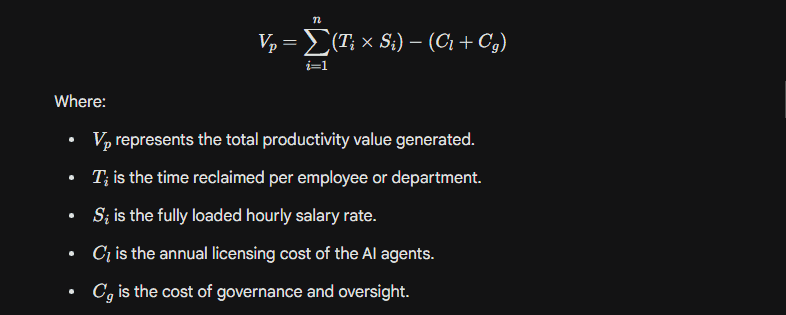
This mathematical rigor allows Chief Financial Officers to move away from “speculative pilots” toward managing AI as a high-performing portfolio of assets. According to the Gartner, CFOs who strategically deploy AI alongside broader finance technology could unlock an additional 10 percentage points of margin growth by 2029.
Deep Dive: Copilot Studio agent workflows and Multi-Agent Orchestration
In 2026, the complexity of business outcomes often exceeds the capabilities of a single AI model. This has led to the rise of multi-agent systems, where specialized agents collaborate to solve intricate problems. This orchestration is the “digital nervous system” of the modern enterprise, ensuring that data flows seamlessly between systems of record and systems of action.
Microsoft Copilot Studio has introduced several critical features that enable this level of coordination. The most notable is the Agent-to-Agent (A2A) protocol, an open standard that allows agents to communicate across different clouds, platforms, and organizational boundaries. This means a Copilot Studio agent can securely invoke an external agent hosted on a different platform to complete a specialized task, such as currency conversion or regulatory validation, without the developer needing to write custom integration code.
The Anatomy of an Orchestrated Workflow
A typical orchestrated workflow in 2026 involves a “Main Orchestrator” that manages several “Expert Sub-Agents.” For example, the “Ask Microsoft” web agent uses this pattern to manage five distinct sub-agents covering Azure, Microsoft 365, pricing, trials, and documentation. When a customer asks a complex question involving multiple products, the orchestrator routes parts of the query to the relevant experts and synthesizes a fast, coherent, multi-turn response.
This level of coordination is supported by six core capabilities identified for 2026 scalability:
-
Intent-to-Agent Conversion: Using natural language to define an agent’s purpose.
-
End-to-End Ownership: Agents that manage processes like expense reimbursements from submission to final audit.
-
Cross-System Action: The ability for agents to navigate web interfaces and fill out forms autonomously via “computer use” capabilities.
-
Model Flexibility: The capacity to toggle between high-performance reasoning models and cost-efficient models based on task priority.
-
A2A Interoperability: Standardized protocols for agent communication.
-
Centralized Scale: Managing agent lifecycle, spend, and quality through a unified admin center.
The integration of Microsoft Fabric further enhances these workflows by allowing agents to reason over vast amounts of enterprise data and analytics at scale. This ensures that the agent’s actions are grounded in the specific business context of the organization, leading to outputs that are more accurate, relevant, and actionable.
Enterprise AI governance 2026: Navigating “Copilot Chaos”
As agents gain the power to act autonomously across an organization’s most sensitive systems, the importance of governance has moved from a back-office concern to a primary strategic pillar. In early 2025, many organizations faced “Copilot Chaos,” where AI systems unintentionally exposed overshared or poorly labeled data to unauthorized users. By 2026, the standard for Microsoft Purview Copilot security has evolved to provide a layered defense that ensures agents remain helpful teammates rather than security liabilities.
Gartner predicts that by 2027, more than 40% of AI initiatives could be abandoned if organizations do not master the fundamentals of governance and ROI. For the SMB, this means implementing a “Zero-Trust Agent” model, where every interaction is authenticated, authorized, and continuously monitored. The governance framework of 2026 is built on three essential pillars: Sensitivity Labels, Data Loss Prevention (DLP), and Auditing.
The Built-In Bouncer: Sensitivity Labels and Encryption
Sensitivity Labels are the foundational control mechanism for agentic security. These labels embed protection directly into the file metadata, ensuring that security follows the data wherever it moves. Copilot and other autonomous agents are programmed to respect these labels; if a file is labeled “Highly Confidential – Finance,” the agent will only process that information for users who have the explicit “EXTRACT” rights for that category. This “security trimming” happens in real-time, preventing the AI from surfacing sensitive salary data or intellectual property to employees who should not have access.
The Traffic Cop: Data Loss Prevention (DLP) for AI
DLP policies have been extended to monitor the AI conversation itself. These policies can detect when a user attempts to paste sensitive information, such as credit card numbers or internal project codes, into an agent prompt. The system can instantly block the prompt and display a policy tip to the user, preventing data from entering the AI’s training or reasoning context. Furthermore, organizations can create “No-Fly Zones” for AI, where agents are entirely blocked from interacting with content related to high-risk projects, even if the user technically has permission to see the file.
The Security Camera: Forensic Auditing and Compliance
In 2026, “the AI did it” is not a valid legal defense. Organizations require total observability into every thought process and decision branch an agent takes. Microsoft Purview provides a Unified Audit Log that tracks who used an agent, when they used it, and which specific resources were accessed. This metadata is critical for forensic investigations and compliance audits, particularly in regulated industries like finance and healthcare where explainability is mandatory.
|
Governance Feature |
2026 Capability |
Risk Mitigation |
|---|---|---|
|
Sensitivity Labels |
Respects encryption and EXTRACT rights |
Prevents accidental data oversharing |
|
DLP for Copilot |
Real-time prompt and response monitoring |
Blocks exfiltration of sensitive info |
|
Communication Compliance |
Monitors prompts for harassment/insider trading |
Ensures ethical and legal AI usage |
|
eDiscovery (Premium) |
KQL-searchable AI interactions |
Facilitates litigation and regulatory review |
|
Human-in-the-Loop |
Interruption protocols for low confidence |
Maintains human oversight of high-stakes tasks |
|
Automated Auditing |
Immutable ledgers of agent decision-making |
Provides clear accountability and trust |
The Human-Agent Workforce: Evolving Organizational Structures
The rise of autonomous agents is not merely a technical shift but an organizational one. McKinsey’s research highlights that the infusion of AI is leading companies to reimagine how work gets done, redefining domains and end-to-end processes. This is resulting in the emergence of “AI-first global business service hubs” that orchestrate work between humans and AI agents to enable scalable innovation.
According to the Gartner 2026 CEO survey, 80% of CEOs expect AI to force a high to medium degree of change to their operational capabilities. This represents a shift toward “autonomous business,” where self-learning software agents and “machine customers” make decisions and take actions that create new types of value. For the SMB owner, this means evolving from a manager of tasks to a leader of systems.
The Evolution of the C-Suite
In 2026, the boundaries between traditional C-suite roles are blurring. The CIO, once focused on IT infrastructure, is now a co-architect of enterprise work resource models, leading AI agent systems across all business functions. The CHRO must manage a hybrid workforce of humans and “digital workers,” ensuring that employees are trained to supervise agents and escalate issues when needed. The General Counsel is tasked with adapting risk and liability models to account for autonomous decision-making.
This organizational shift is characterized by several tectonic forces:
- Dual Transformation: Successful organizations are pursuing a simultaneous transformation of both their technology stack and their people capabilities.
- Human-Centric Leadership: As AI takes over routine administrative work, the emphasis on human-centric skills—empathy, ethics, and strategic judgment—becomes even more critical.
- Digital Identity Management: One of the largest risks in 2026 is the lack of oversight over the growing volume of non-human “digital identities” operating within a business. Managing these identities is now a core security requirement.
High-Impact Industry Use Cases: Agents in Action
The real-world impact of Autonomous AI Agents for Business is most visible in sectors with high-volume, structured workflows. By 2026, these deployments have moved from experimental pilots to production-grade infrastructure that sits alongside ERP and CRM systems.
Retail and E-commerce: The Self-Driving Supply Chain
In the retail sector, AI agents are mediating a significant portion of e-commerce sales. Merchants are prioritizing making their product data machine-readable, as an agent cannot recommend or purchase an item it cannot understand. Furthermore, agents are optimizing inventory management by predicting demand and negotiating with carriers autonomously. One global retailer reported saving 300 hours of human work per week while achieving zero delays in inventory during a major regional port strike by utilizing autonomous orchestrators.
Finance and Professional Services: Automated Compliance and Reporting
Finance teams are utilizing agents to automate reconciliation, manage cash gaps, and optimize tax liabilities. In high-stakes environments, agents are performing autonomous compliance audits. A bank needing to audit 10,000 loan applications for bias and regulatory adherence used an “OCG Compliance Agent” to complete the task in just four hours—a process that previously took four weeks of manual human review.
Healthcare: Intelligent Triage and Monitoring
In the healthcare sector, AI integration is extending “digital front doors” through autonomous triage and patient portals. AI agents are converting raw clinical data into ranked options for clinicians, compressing decision time in critical care environments like radiology and cardiology. These systems are engineered with strict HIPAA compliance and “interruption protocols” to ensure that any action with potential medical consequences is flagged for human clinician approval.
Manufacturing: Dynamic Scheduling and Quality Control
Manufacturing facilities are deploying agents connected to vision systems and sensor networks. These agents monitor dozens of variables simultaneously, detecting statistical drift before it results in defects. They can autonomously adjust machine parameters or quarantine a batch in a closed loop, significantly reducing scrap rates and latency in problem detection.
The 2026 Roadmap: Transitioning Your SMB to Autonomy
Transitioning to an agentic workforce is a journey that moves from “innovation theater” to “outcome-led” AI. For SMB owners, the roadmap to 2026 success involves four distinct phases designed to build trust, ensure security, and maximize ROI.
Phase 1: The “Lighthouse” Strategy (Days 1–30)
The goal of the first phase is to prove value quickly without disrupting core operations. Organizations should select one low-risk, high-volume workflow, such as invoice reconciliation, password resets, or customer lead hygiene. Using(Microsoft Copilot Studio), the business can map the process and deploy a specialized agent in a controlled “sandbox” environment.
Phase 2: System and Tool Integration (Days 31–60)
Once the pilot proves successful, the agent must be integrated into the organization’s existing systems of record (CRM, ERP, and Microsoft 365). This phase focuses on “Custom Reasoning and Knowledge Curation,” ensuring the agent has access to the high-quality, up-to-date data it needs to make accurate decisions. This is where the organization builds the “context layer” that acts as the agent’s brain.
Phase 3: Autonomous Deployment and Performance Governance (Days 61–90)
In this phase, the agent is moved into full production. Strict “interruption protocols” are established, ensuring the agent pings a human supervisor if its confidence threshold drops below a certain level. Governance controls through Microsoft Purview are activated to monitor agent actions and maintain a comprehensive audit trail. Success is measured not just by time saved, but by the “success rate per execution” and the agent’s ability to self-correct.
Phase 4: Scaling the Digital Workforce (Day 91+)
The final phase involves expanding the agentic footprint across other departments. Organizations shift toward multi-agent orchestration, where specialized agents from different functions begin to collaborate. This creates a “value flywheel” where the efficiency gains from early agents are intentionally reinvested into more complex, higher-value autonomous workflows.
Navigating the Challenges and Ethics of Autonomy
Despite the massive potential of Autonomous AI Agents for Business, the transition is not without its hurdles. Leaders must bridge a significant “trust gap”; while most users trust agents for routine data analysis, high-stakes interactions like financial transactions still require human oversight. Organizations must be transparent about when an agent is acting on their behalf and maintain a “Human-in-the-Loop” (HITL) framework to manage risk.
Furthermore, the risk of “agentic drift”—where autonomous workflows produce cascading errors over time—requires robust monitoring and “kill switches” that can halt agent actions immediately. Industry executives recommend that in 2026, half of enterprise ERP vendors will launch autonomous governance modules that combine explainable AI with real-time compliance monitoring.
Ultimately, the real winners in 2026 will not necessarily be the companies with the most agents, but those that master the orchestration layer and bridge the trust gap. As BCG and Capgemini data suggests, the move toward agentic AI is as much an organizational change as it is a technological one. SMBs that move from reacting to technology to actively shaping it—regularly stress-testing their operating models and leadership roles—will be the ones that thrive in the era of “business as change”.
Conclusion: The Competitive Advantage of the Agentic Era
By 2026, the transition to Autonomous AI Agents for Business has become the primary differentiator between industry leaders and laggards. The focus has moved from the “hype” of 2025 to the “results” of the autonomous era, where digital teammates handle end-to-end workflows without being asked. For the SMB owner, the emphasis is no longer on short-term resilience, but on sustained productivity and long-term impact powered by AI at the core of organizational transformation.
The business case is clear: with 14 minutes reclaimed per day per user, a net benefit of $2,440 per user annually, and efficiency gains of up to 80% in targeted areas, the shift to autonomy is a prerequisite for scaling in the modern economy. However, this power must be balanced with strict security and governance. By leveraging tools like Microsoft Purview Copilot security, organizations can transform AI from a potential liability into a controlled, enterprise-ready accelerator.
As multi-agent orchestration becomes the backbone of leading enterprises, the focus remains on the “human layer” of technology. Success in 2026 relies on humans and AI agents collaborating as partners, redefining roles, and building the capabilities necessary to navigate an increasingly complex, high-stakes world. For those ready to lead, the first step is moving beyond the prompt and integrating agentic workflows into the existing Microsoft ecosystem to drive real, measurable ROI.
Take the Next Step. The business case is clear. The technology is ready. The only remaining variable is your leadership.
Schedule a Free call with us.
Start Your Journey.

Related Articles

Microsoft Purview Copilot Security: How to Stop Copilot Chaos Before It Exposes Your Data
Last Updated 5 months ago ago Microsoft 365 Copilot is powerful, sometimes too powerful. While it can summarize documents, generate…
Read Article →
Microsoft Copilot Business Case: The Proven ROI Behind the $30/User Investment
Why the Microsoft Copilot Business Case Matters Now The modern workplace is at a defining moment, one comparable to the…
Read Article →
Security Through Obscurity Is Dead: How Copilot Exposes Hidden Risks in Your Data
The rise of AI in the workplace is a huge moment in tech almost as big as the move to…
Read Article →Need help with your Microsoft solutions?
Speak with our certified experts and find the right path for your organization.